Designed for Success
The common air-push pumps on site were not designed for elevated temperatures. With leachate continuing to accumulate, landfill gas was pushed into the open air, beyond the site's ability to capture and flare it, and migrated into nearby basements. A court ordered improvement and mandated dewatering of at least 120,000 gallons per month.
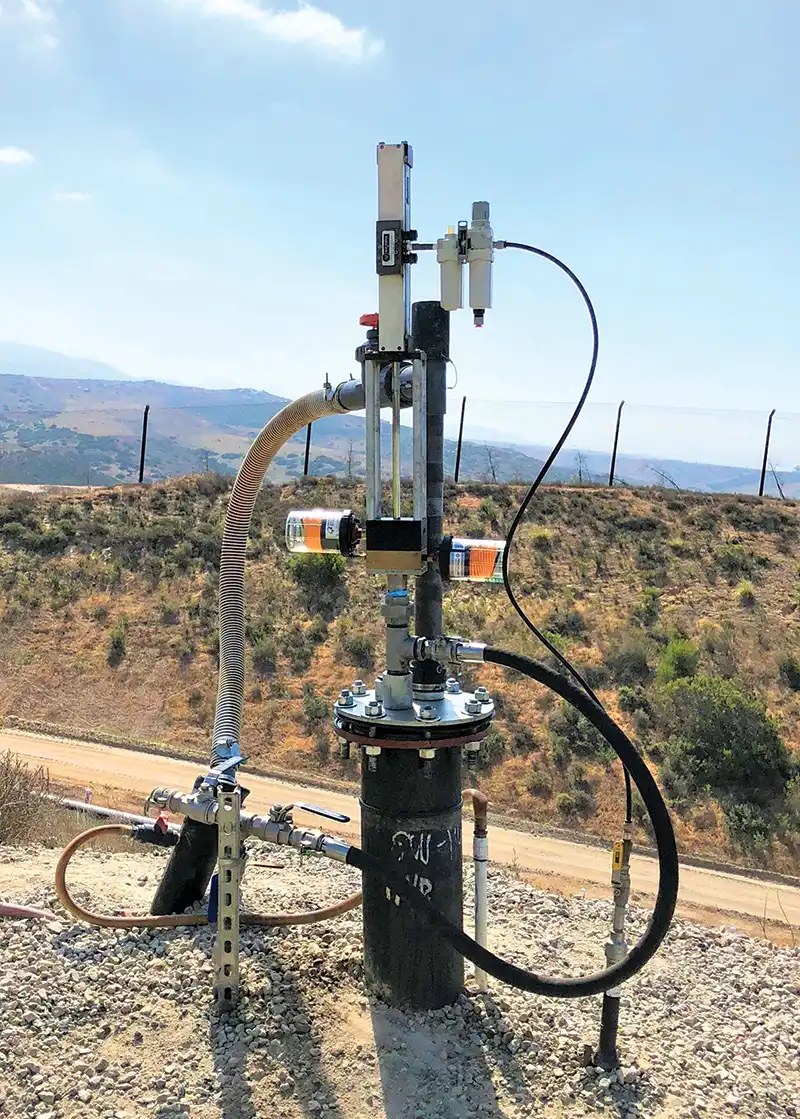
Managers installed several Blackhawk top-head-drive, positive-displacement pneumatic piston pumps in the area where common air-push and submersible models failed.
Unlike common air-drive models, piston pumps can be built with materials of construction that withstand heat to 300°F+ (150°C). They will pump virtually anything flowable, regardless of composition, pH, viscosity, grit or vacuum while resisting biological and chemical attack.
By design, piston pumps cannot introduce oxygen into the discharge system or exhaust landfill gases into the atmosphere. Drivers are mounted above the wellhead, and all power and drive components are above ground for safer and faster maintenance.
Pumping Partnerships
The Blackhawk pumps notably outperformed the other pump styles, although issues surfaced as more piston pumps were added, including relatively rapid seal wear and field technicians' unfamiliarity with the new pumps.
In the spirit of need and opportunity for growth, the landfill's management team partnered with Blackhawk to diagnose problems, better understand what was happening at the most challenging wells, and develop new design concepts and test new materials to meet unique needs.
Now, 10 years later, both the actively managed landfill and Blackhawk have benefited significantly from the mutual exchange of ideas and continuous onsite proof testing.
"Blackhawk pumps work when others can't," said the manager. "They go deeper and last longer. They are easier and faster to maintain and repair, which means less down time. And we can work with Blackhawk to improve how we pump."