THE NEED FOR A BETTER APPROACH
As sampling requirements evolved, operators needed a more reliable and precise way to collect groundwater samples, especially at greater depths.
The goal was clear:
- Reach deeper groundwater levels with confidence
- Eliminate the risk of compressed air entering the sample well
- Support both high- and low-flow groundwater sampling conditions, including high purge rates when required
- Maintain consistent, controlled sampling performance
Traditional methods could not consistently meet these requirements, prompting the search for a better solution.
A NEW WAY TO PUMP
To address these challenges, Blackhawk implemented its top-head drive, positive-displacement piston pump as a dedicated sampling solution.
The system utilized a 101-piston pump with multiple top-head drive options, including compressed air (V2), solar (Apollo), or electric-powered configurations, allowing flexibility based on site conditions.
Unlike traditional bladder pumps, this system:
- Eliminates the need for a bladder, removing a key failure point
- Prevents compressed air from entering the well
- Maintains a constant flow rate independent of liquid depth or pressure
- Supports both high and low flow sampling, with simple flow rate adjustment
- Is capable of pumping groundwater up to 2 gpm (7.6 Ipm) at depths up to 500 feet
- Operates effectively at greater depths, including wells exceeding 100 feet
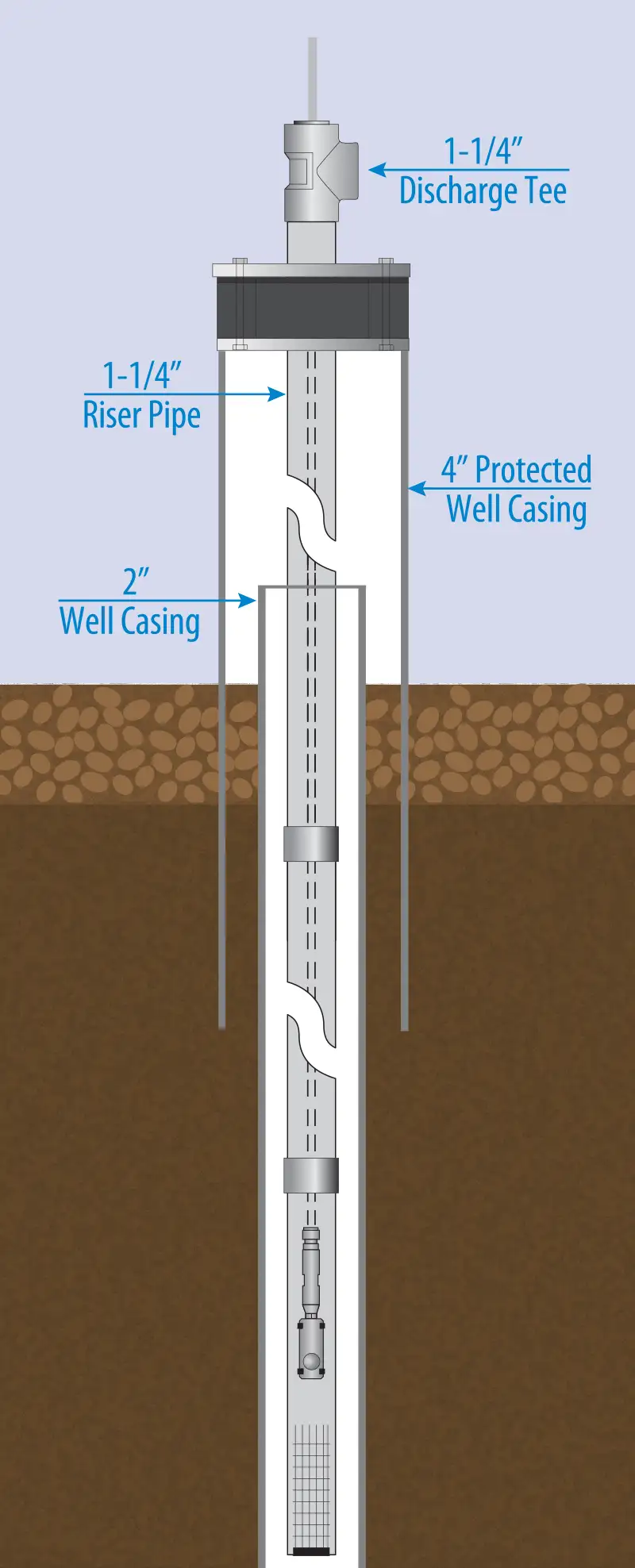
- Fits within standard 2” monitoring well casings
- Features a slender pump barrel (max OD 1.9 in.) for easy deployment
- Pumps without disturbing the sampled fluid
Installed as a permanent downhole piston pump with a removable top-head drive motor and secure stainless steel well cap, the system is designed for both durability and ease of use in the field. The top-head drive motor can be easily removed at the wellhead, simplifying operation and transport between sampling events.
Operating at controlled rates at approximately 0.05 gallons per stroke for low-flow sampling, the pump functions similarly to a medical syringe, delivering discrete, undisturbed samples with each cycle while also accommodating higher purge rates when needed.
CONSISTENT PERFORMANCE IN THE FIELD
Once implemented, the Blackhawk sample pump significantly improved both sampling reliability and operational efficiency.
Operators reported:
- More reliable, repeatable groundwater samples
- Simplified sampling operations
- Faster sampling events
- Improved consistency across wells
Because each piston stroke delivers a controlled, discrete sample, the system minimizes disturbance and preserves sample integrity eliminating the variability seen with previous methods.
Additional benefits included:
- No risk of compressed air entering the well
- Elimination of bladder failures and replacement cycles
- Reduced equipment required in the field
- Dedicated downhole pumps for each well, reducing cross-contamination risk
LESS MAINTENANCE. MORE CONFIDENCE.
By removing the limitations associated with bladder-based systems, the Blackhawk pump provides a more dependable and efficient sampling process.
Operators benefit from:
- Improved field efficiency and simplified workflows
- Reduced maintenance and fewer equipment failures
- More secure, reliable groundwater samples
- Greater confidence in data accuracy
The system’s simple mechanical design, independent of pressure and powered by a top-head drive, ensures consistent performance across a range of conditions. While initial upfront costs may be higher, operators noted that these are offset over time through reduced maintenance, longer service life, and improved sampling reliability.
BEYOND BLADDER PUMPS
While bladder pumps have long been used for low-flow sampling, their design introduces limitations that can impact long-term performance, particularly in deeper wells or demanding conditions.
Blackhawk’s top-head drive piston pump delivers the same low-disturbance sampling advantages without the drawbacks of bladder wear, compressed air contamination, or inconsistent flow.
The result is a more adaptable, durable, and precise solution, especially in applications requiring deeper sampling depths and higher confidence in data integrity